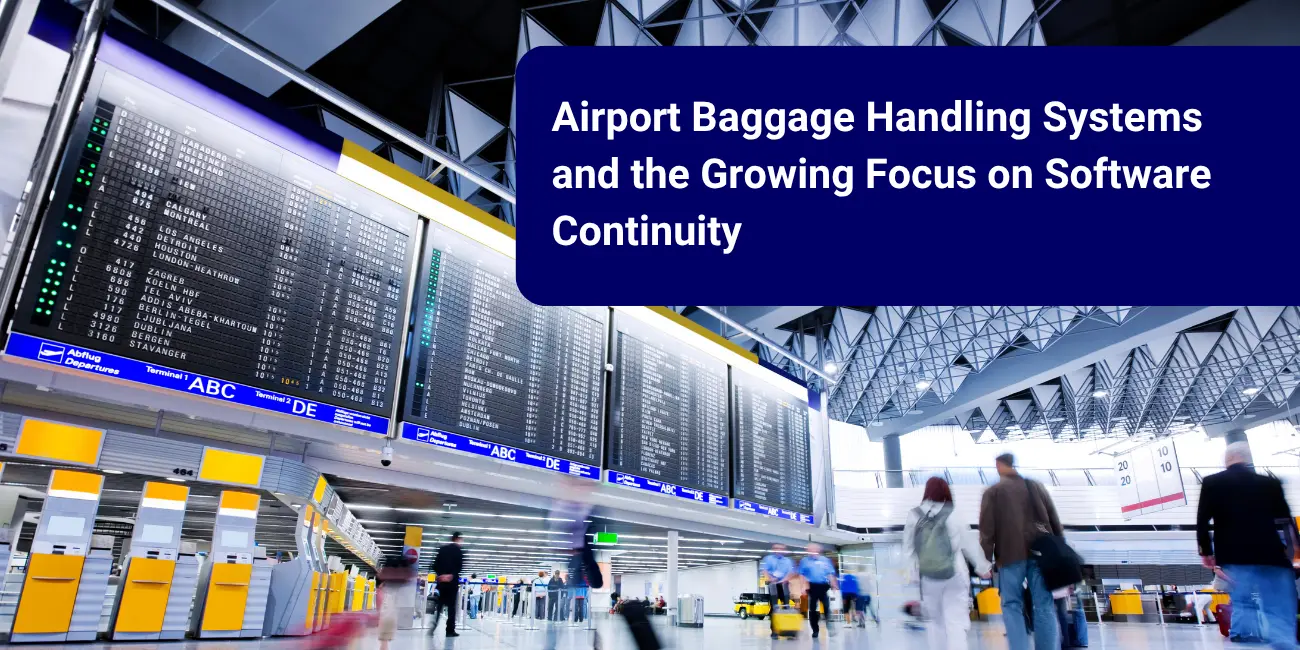
Airport Baggage Handling Systems and the Growing Focus on Software Continuity
Across the aviation sector, airport software continuity is increasingly being discussed through a technology lens. As airports become more dependent on third-party software and cloud-based services, ensuring continuity during supplier disruption is becoming a key operational resilience priority.
Airports have always depended on physical infrastructure, specialist suppliers and carefully managed processes. But many of the systems that keep passengers, baggage and aircraft moving now rely on complex software, SaaS platforms, cloud environments and third-party technology providers.
That shift is particularly visible in airport baggage handling systems (BHS). Behind the belts, scanners, conveyors and sortation equipment sits a software layer. It controls routing, tracking, monitoring and integration with airport and airline systems.
As airports modernise, airport software continuity measures such as software escrow and SaaS continuity are becoming more relevant to procurement, tendering and supplier risk management.
Why Airport Software Continuity Is Moving Up the Agenda
Recent disruption across aviation has highlighted how quickly technology issues can become operational issues. Reservation platforms, check-in systems, baggage processing, flight operations tools and cloud-hosted applications all play a role in keeping airports moving.
While each airport and supplier relationship differs, the underlying question remains consistent: if a critical technology provider can no longer support a system, enters insolvency or breaches its contractual obligations, what happens next?
For airport operators, that question is not only about cyber incidents or data loss. It is also about supplier continuity. Organisations need access to technical materials and practical options for rebuilding or transitioning applications while alternative arrangements are made.
Baggage handling systems as a practical example
Baggage handling is a useful example because it combines physical infrastructure with specialist software. The belts and conveyors may be visible, but the routing, sorting, tracking and monitoring are often controlled by applications that must integrate reliably with airport, airline and ground-handling systems.
If a baggage application becomes unavailable, unsupported or difficult to transition, it can affect far more than the software team.
This is one reason why software escrow and SaaS escrow are becoming more relevant in conversations around vendor failure, airport technology procurement and operational resilience.
From supplier due diligence to continuity planning
Supplier due diligence remains essential. Airports and aviation technology buyers need to understand a vendor’s financial standing, security posture and technical capability. They should also assess service commitments.
However, continuity planning asks a slightly different question. It looks beyond whether the supplier is suitable today and considers what would happen if the supplier could no longer provide, maintain or support the application in the future.
For business-critical systems, airports should understand whether they or a replacement provider can access the materials needed to maintain service. Those materials may also be required to rebuild the application or support a transition.
Those materials may include source code, configuration files, build instructions and technical documentation. For cloud-hosted applications, a SaaS escrow agreement may also need to consider the wider hosting environment, databases, and deployment scripts. It should also address how the service can be activated or replicated under defined conditions.
This is where traditional third-party risk management begins to overlap with technology continuity planning. Assessing supplier risk is only part of the challenge; organisations must also determine how they would maintain critical technology services if a supplier could no longer support them.
What aviation buyers may want to consider
- What technology is genuinely business-critical?
Not every application needs the same level of protection. Organisations should understand which systems could materially affect operations, passengers, revenue or regulatory obligations if they became unavailable.
- What does the application depend on?
Source code may be only one part of the picture. APIs, databases, cloud infrastructure, third-party components, deployment scripts, containers, documentation and configuration may all be needed.
- What rights exist if the supplier fails?
Contracts should clearly establish the circumstances in which continuity materials become available and what the customer is permitted to do with them.
- Has the recovery process actually been tested?
Holding source code is very different from proving that the deposited materials can be built, deployed and used.
- How would the organisation transition to an alternative arrangement?
Continuity does not always mean operating the supplier’s application indefinitely. It may mean maintaining the service long enough to migrate to another provider or bring the application under alternative support.
How software escrow and SaaS escrow support operational resilience
Software escrow provides an independent framework for holding and maintaining agreed continuity materials. It brings together the technology supplier, the customer and an independent escrow provider under an agreement that sets out what is deposited, how it is updated and when it may be released and utilised for continuity purposes.
For traditional on-premise software, source code escrow focuses on source code, binaries and supporting documentation needed to maintain or rebuild the application. For SaaS and cloud-hosted systems, continuity arrangements will go further and often include infrastructure, deployment assets and environments needed to recreate, migrate or replicate the service.
Verification and Replicated Environments
Independent verification and testing confirm that organisations can use the deposited materials, rather than simply storing them as a static archive.
For particularly critical SaaS environments, including those supporting time-sensitive aviation processes, some organisations may also consider a replicated environment to support continuity under agreed release conditions.
Aviation Case Study: SaaS Continuity in Practice
The Escrow Company has seen this principle tested in a real aviation environment. An international airline relied on a SaaS provider for its business-critical online booking and seat allocation system. As part of its continuity planning, the airline established a SaaS escrow arrangement that included the source code, database, deployment scripts, technical documentation and a replicated cloud environment. Independent specialists also verified the deposited application. When the SaaS provider later entered administration, the escrow arrangement was triggered. The Escrow Company brought the replicated environment online, allowing the airline to continue operating without missing a reservation.
Through The Escrow Company’s Managed SaaS Continuity service, the airline maintained continuity while keeping the booking platform available to users. The system and associated materials were subsequently transferred to the airline so that it could continue managing the application independently. That example highlights an important distinction. The value of continuity planning is difficult to measure when everything is working. Its value becomes very clear when a critical supplier can no longer provide the service.
Aviation continuity in practice
The real test of airport software continuity is not whether everything works while the supplier is healthy. It is whether the airport knows what happens if the supplier can no longer provide the system at all.
That means identifying which applications are genuinely critical, understanding what they depend upon, confirming what rights exist if the supplier fails and testing whether the necessary materials can actually be used.
For airport operators and aviation technology suppliers, the question is not whether SLAs, backups and disaster recovery matter. They do.
The sharper question is whether those measures would still be enough if a critical technology provider disappeared tomorrow.
The Escrow Company works with organisations and technology suppliers worldwide to design Software Escrow, SaaS Escrow, Verification and SaaS Continuity solutions around the systems they depend upon.
Talk to our team about protecting a critical aviation application and closing the supplier-failure gap in your operational resilience strategy.